

Diagnostic Interrogation & Root-Cause Computer Analysis
Precision fault isolation in Bend, OR. We do not guess or swap parts—we verify physical circuit health, sensor telemetry, and digital serial data.
Looking for deep multiplex network or module programming?
For intermittent bus blackouts, parasitic draw, and OEM J2534 pass-thru flashing, explore our
Forensic Electrical & Network Diagnostics Laboratory →
Beyond Generic Scanners
Parts stores pull generic DTC codes that only confirm an engine computer detected a parameter threshold violation. We interrogate live parameter IDs (PIDs), capture freeze-frame registers, and calculate actual mass airflow and fuel-trim dynamics.
Lab Scope Verification
When computers register misfire or timing faults, we deploy multi-channel digital storage oscilloscopes to measure injector current ramp profiles, primary/secondary ignition waveforms, and crank-cam phase correlation at component pins.
Factory-Level Interrogation
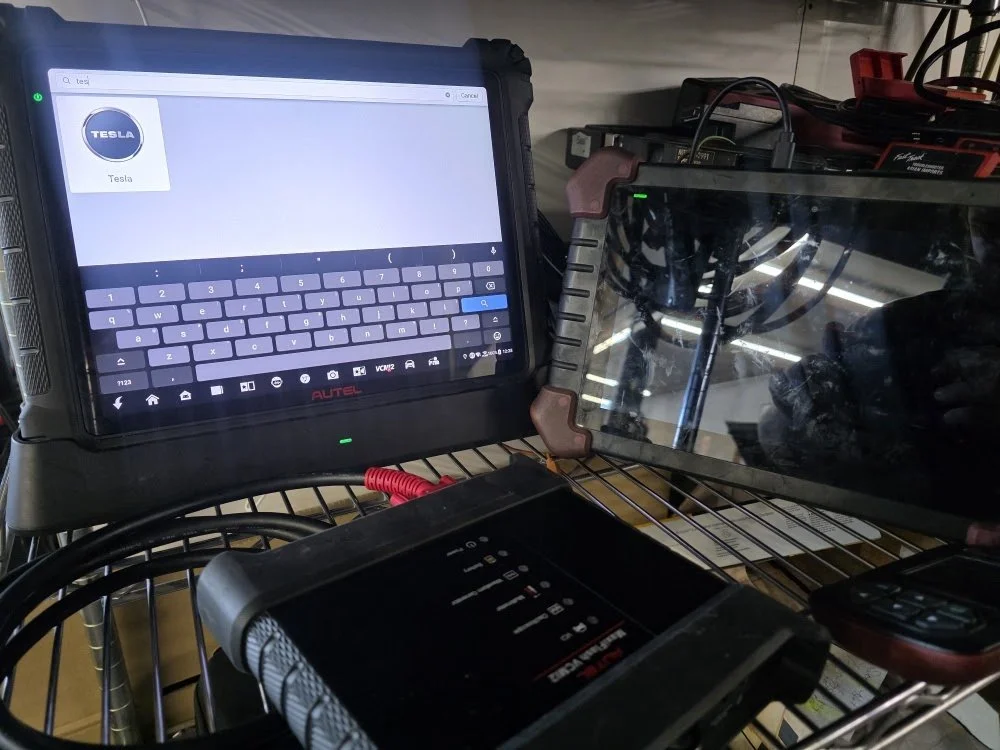
Equipped with Autel MaxiSys Ultra S2, Matco Maximus 3.0, and high-speed VCMI interfaces to run bi-directional actuator tests, evaporative system leak decays, and live cylinder balance evaluations on European and domestic platforms.
Reserve a Forensic Diagnostic Bay
Eliminate the trial-and-error parts guessing. Have our master diagnostic technicians inspect your circuit or powertrain system.
Frequently Asked Diagnostic Questions
Why not just replace the sensor listed in the check engine code?
A code indicates an out-of-range signal; it does not identify what caused the variance. For example, an O2 sensor lean fault code can be triggered by a vacuum leak, low fuel pressure, exhaust manifold cracks, or grounding circuit resistance. Replacing the sensor rarely cures the underlying problem without circuit verification.
Can you communicate with European and classic vehicle computers?
Yes. We support modern CAN, CAN-FD, FlexRay, and DoIP architectures on European platforms (Porsche, BMW, Audi, Land Rover, Jaguar), as well as legacy ALDL and serial protocols on OBD-1 classics using dedicated legacy tooling.